From Seed to Shipment: A Practical Guide to Exporting Medical Cannabis to Europe
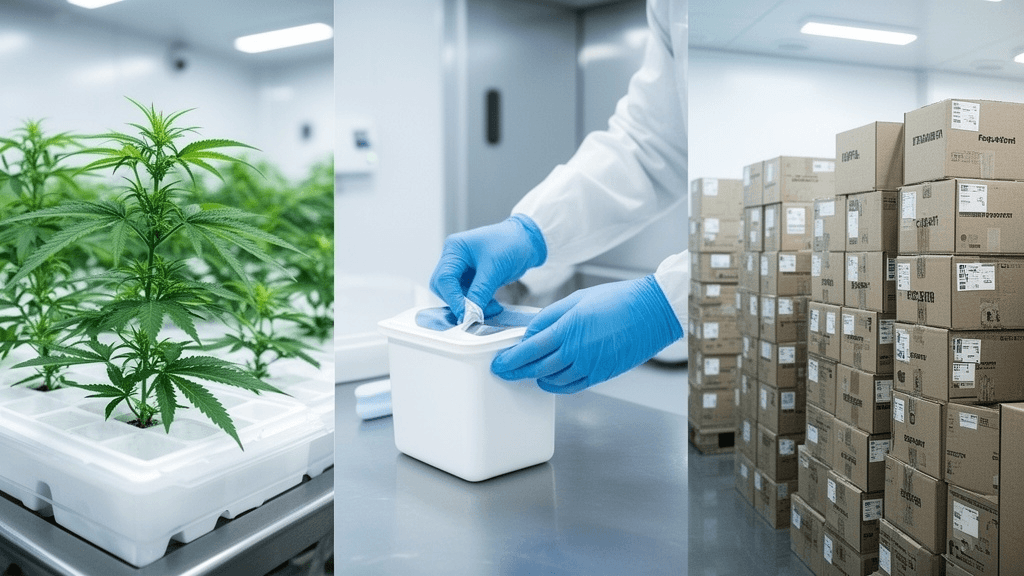
The two preceding articles in this series examined why Germany's medical cannabis market is expanding at triple-digit growth rates and why African cultivation economics make that demand commercially relevant to producers on this continent. This third instalment answers the practical question those articles leave open: what, exactly, does a South African cultivator need to do — and in what sequence — to legally ship compliant dried flower to a European buyer?
The full certification stack at a glance
Before examining each requirement in detail, the table below provides a single reference showing every certification or licence in the chain from a South African cultivation facility to a European pharmacy shelf.
| # | Certification / Licence | Issuing Authority | What It Covers | Indicative Timeline |
|---|---|---|---|---|
| 1 | Section 22C(1)(b) Licence | SAHPRA | Authorisation to cultivate, manufacture, extract, test, import, export, and/or distribute cannabis | 12–24 months |
| 2 | Section 22A(9)(a)(i) Permit | Director-General of Health (South Africa) | Permit to possess, manufacture, and supply Schedule 6 substances; ensures INCB quota compliance | Concurrent with #1 |
| 3 | GACP Compliance | SAHPRA inspection + third-party audit | Good Agricultural and Collection Practices for cultivation and harvesting | 3–9 months |
| 4 | SA GMP Certificate | SAHPRA | GMP compliance for post-harvest processing (PIC/S-aligned) | 6–12 months after licence |
| 5 | Written Confirmation of GMP | SAHPRA or EU Member State NCA | Confirms GMP equivalence for export of APIs to the EU | 2–6 months after SA GMP |
| 6 | European Pharmacopoeia Compliance (Ph. Eur. 3028) | Accredited laboratory testing | Product quality: cannabinoid content, microbial quality, heavy metals, pesticides, aflatoxins | Per batch; ongoing |
| 7 | INCB Export Permit | SAHPRA / Department of Health | Per-consignment export authorisation under the UN Single Convention 1961 | 2–4 weeks per shipment |
| 8 | Destination Country Import Authorisation | Varies: BfArM (Germany), Home Office + MHRA (UK), etc. | National import licence and per-consignment import permit | 3–16 weeks |
The critical insight is that items 1 through 5 form the sequential critical path, while items 6 through 8 are ongoing operational requirements. Getting the sequence and concurrency right is the difference between a 16-month fast track and a 30-month slog.
The SAHPRA Section 22C(1)(b) licence: your foundation permit
Everything begins with SAHPRA. The Section 22C(1)(b) licence under the Medicines and Related Substances Act 101 of 1965 is the foundational authorisation that permits a South African entity to cultivate, manufacture, extract, test, import, export, and distribute medicinal cannabis. Without it, touching the plant in a commercial context is a criminal offence.
The application is submitted to SAHPRA's Cannabis Inspectorate and must include a Site Master File describing the facility in exhaustive detail — layout drawings, HVAC schematics, water systems, equipment lists, and process flows. A Responsible Pharmacist registered with the SA Pharmacy Council must be appointed. The application also requires a comprehensive security plan, a documented Quality Management System aligned with PIC/S GMP principles, and third-party agreements with seed banks, waste management companies, laboratory testing facilities, and offtake agreements demonstrating market access.
SAHPRA's published application fee is R23,980, with inspections charged at R714 per hour. The application fee is non-refundable.
A frequently misunderstood feature is that applications may be submitted on the basis of a site plan and Site Master File before the facility is constructed. SAHPRA's official guideline explicitly confirms this. However, the licence itself is issued only after the completed facility passes a compliance inspection. This means applicants can enter the 12-to-24-month approval queue while construction proceeds in parallel — a planning advantage that disciplined operators exploit to compress the overall timeline.
Realistic processing timelines run 12 to 24 months from submission to licence issuance. Licences are valid for five years and are subject to suspension or revocation for non-compliance.
GACP compliance: the agricultural quality foundation
Good Agricultural and Collection Practices form the first link in the pharmaceutical quality chain. GACP governs everything from seed selection through cultivation, harvesting, and primary processing. For European offtakers, GACP compliance is non-negotiable: EU GMP Annex 7 explicitly requires that starting materials be sourced from GACP-compliant operations.
The foundational reference is the WHO Guidelines on Good Agricultural and Collection Practices for Medicinal Plants, but the operative European standard is the EMA Guideline (EMEA/HMPC/246816/2005). A significant Revision 1 was adopted in 2025, whose most important change for cannabis operators is the explicit inclusion of indoor and controlled-environment cultivation — the original guideline was drafted with field-grown medicinal plants in mind.
In the South African context, GACP compliance is assessed by SAHPRA as an integral part of the Section 22C licensing inspection. However, European offtakers require independent third-party evidence. The leading standard is Control Union's CUMCS-GAP, fully aligned with WHO and EMA GACP guidelines. GACP certification costs are estimated at $50,000 to $200,000 depending on facility complexity, with timelines of three to nine months.
Key GACP requirements include facility design with contamination prevention, personnel training covering botanical knowledge and hygiene, documented cultivation practices with integrated pest management, harvesting at optimal quality with full traceability, and rigorous batch-level documentation.
GMP certification: where South Africa's PIC/S membership becomes a strategic asset
The distinction between SA GMP and EU-GMP is the single most misunderstood element of the export pathway.
South Africa joined PIC/S in July 2007 — the first and only African country to achieve membership. SAHPRA's SA Guide to Good Manufacturing Practice directly adopts the PIC/S Guide to GMP, which is technically harmonised with EU-GMP (EudraLex Volume 4).However, PIC/S membership does not create automatic mutual recognition of GMP certificates with the EU. South Africa does not have a formal Mutual Recognition Agreement with the EU — the EU's operational MRAs are limited to Australia, Canada, Israel, Japan, New Zealand, Switzerland, the UK, and the United States.
What PIC/S membership does provide is a credible foundation that enables SAHPRA to issue a "Written Confirmation of GMP" under Article 46b(2)(b) of Directive 2001/83/EC. This mechanism requires that active pharmaceutical ingredients imported into the EU from third countries be accompanied by written confirmation from the exporting country's competent authority attesting that the manufacturer's GMP standards are at least equivalent to EU standards.
The practical pathway involves a five-phase process: gap analysis (2–8 weeks), facility upgrades and remediation (3–12 months), pre-audit (2–4 weeks), official inspection (3–5 days on-site), and certification. For a purpose-built facility designed for GMP from the blueprint, Phases 1–5 can be completed in 6 to 12 months from construction completion. For a retrofit, the timeline extends to 12 to 24 months.
There is also a faster route. Since EU-GMP certification is required for post-harvest manufacturing, not cultivation itself, a cultivator can obtain GACP certification and partner with a third-party EU-GMP-certified processor in Europe. This reduces capital requirements from $1.5–10 million to $50,000–200,000 for GACP certification, compressing the timeline to 3 to 9 months — at the cost of reduced per-unit margins.
INCB quotas and export permits
Every cross-border movement of medicinal cannabis is governed by the 1961 Single Convention on Narcotic Drugs. Each signatory country submits annual estimates of its requirements, which become the effective ceiling on quantities.
Germany's 2025 experience is the definitive case study. Germany submitted a 2025 import estimate of 122 tonnes, which was exhausted by mid-September 2025. BfArM ceased approving new import authorisations for approximately five weeks before confirming an upward revision to approximately 192.5 tonnes.For South African exporters, the quota system means your destination country must have sufficient headroom, and the per-consignment export permit process adds approximately two to four weeks of administrative lead time per shipment.
European Pharmacopoeia compliance: the quality specifications your flower must meet
The European Pharmacopoeia monograph 3028 — Cannabis Flower — became legally binding on 1 July 2024 and defines the quality specifications every batch must meet.
Monograph 3028 defines three cannabis types based on cannabinoid content: THC-dominant, THC/CBD-intermediate, and CBD-dominant. When prescribed as a medicinal product, measured contents must not deviate by more than ±10%. Total CBN may not exceed 1.0%.
| Parameter | Specification |
|---|---|
| Cannabinoid content | Per type; ±10% of label claim for medicinal use |
| Total CBN | ≤ 1.0% |
| Loss on drying | ≤ 12.0% |
| Foreign matter | ≤ 2%; no seeds |
| Cadmium | ≤ 0.3 ppm (medicinal product) |
| Lead | ≤ 0.5 ppm |
| Arsenic | ≤ 0.2 ppm |
| Mercury | ≤ 0.1 ppm |
| Microbial quality (oral) | TAMC ≤ 10⁵ CFU/g; TYMC ≤ 10⁴ CFU/g |
| Microbial quality (inhalation) | TAMC ≤ 10² CFU/g; TYMC ≤ 10¹ CFU/g |
| Aflatoxin B1 | ≤ 2 µg/kg |
The microbial limits for inhalation-route products are orders of magnitude stricter than oral-use limits and exceptionally challenging for a natural botanical product. Most operators rely on validated decontamination techniques such as gamma irradiation.
Per-batch testing costs for full compliance at an accredited European laboratory range from €1,500 to €3,500, with turnaround times of 10 to 15 working days.
Destination country import requirements
Germany requires importers to hold two distinct permits: a general permit and a separate import permit for each consignment. Critically, each cultivar requires a separate marketing application — a significant administrative requirement. Upon arrival, every batch must undergo Qualified Person (QP) batch release. The United Kingdom operates a dual-regulator system. The Home Office issues controlled drug licences for import, while the MHRA requires importers to hold a Manufacturer's (Specials) Licence and provide 28 days' notice before import. Other EU markets are growing rapidly. Poland's imports have doubled annually. The Czech Republic has expanded GP prescribing rights. In each case, the cultivator's certifications — GACP, GMP, and Ph. Eur. compliance — are the prerequisites that make import possible.A realistic timeline from decision to first export
Scenario 1 — Optimistic (14–16 months via contract processing): Submit SAHPRA application on site plan while constructing a GACP-compliant facility. Implement GACP in parallel. After SAHPRA licence issuance, begin cultivation and ship to an EU-GMP contract processor. First QP-released product reaches the European market in 14–16 months. Scenario 2 — Conservative (24–30 months for own-facility GMP): Build a purpose-built dual GACP/GMP facility. Complete SAHPRA licensing, then SAHPRA GMP certification and Written Confirmation. First export from own GMP facility in 24–30 months — higher margins but longer timeline.The critical difference is concurrency. SAHPRA explicitly allows applications on site plans before construction. GACP implementation can run in parallel. Offtake agreements can be negotiated while SAHPRA processes the licence. Every week saved on the critical path is a week of earlier revenue.
Ten common mistakes and how to avoid them
1. Building to agricultural standards and then retrofitting for GMP. Retrofit costs routinely exceed what a purpose-built GMP facility would have cost. Design for your end-state certification from the blueprint. 2. Underestimating the documentation burden. A pharmaceutical QMS requires approximately 50 SOPs. Documentation development should begin during facility construction, not after. 3. Selecting the wrong pesticides. The default MRL of 0.01 mg/kg under EU Regulation 396/2005 is effectively zero tolerance. Only biological pest management methods should be used. 4. Assuming laboratory results transfer between markets. A South African certificate of analysis does not substitute for EU-accredited batch testing. Re-testing at an EU laboratory is mandatory for third-country imports. 5. Conflating SAHPRA licence with GMP certification. A Section 22C licence authorises cultivation under South African law. It does not confer GMP status. A separate GMP certificate application is required. 6. Ignoring the per-cultivar import authorisation requirement in Germany. BfArM requires separate marketing applications for each cannabis cultivar. Cultivar selection should be coordinated with your offtaker's regulatory strategy. 7. Failing to plan for microbial decontamination. Meeting inhalation-route limits of TAMC ≤ 200 CFU/g is nearly impossible for unprocessed botanical material. Budget for and validate a decontamination step. 8. Underestimating INCB quota dynamics. Even large import quotas can be exhausted mid-year. Diversify across multiple destination markets where possible. 9. Neglecting stability data. European offtakers require stability data demonstrating product meets specifications throughout its declared shelf life. Begin stability studies as soon as representative batches are available. 10. Treating regulatory strategy as sequential rather than concurrent. The operators who take 30 months instead of 16 almost always make the same mistake: they wait for one approval before beginning the next.Where the pathway leads
The regulatory architecture is demanding, expensive, and slow. That is the point. The certification stack exists because dried cannabis flower destined for a European pharmacy is a pharmaceutical active substance, and patients depend on its consistent quality, safety, and efficacy.
Three structural realities define the landscape for South African exporters. First, South Africa's PIC/S membership and SAHPRA's ability to issue Written Confirmations of GMP provide a regulatory pathway that very few African countries can match. Second, the contract-processing model offers a faster, lower-capital route to market. Third, European demand is growing faster than anyone predicted — Germany's Q1–Q3 2025 imports reached 143 tonnes, already double the full-year 2024 total, and supply, not demand, is the binding constraint.
The cultivators who will succeed are those who treat regulatory compliance not as a hurdle to be cleared but as a competitive moat.
Stay informed
European Cannabis Market Intelligence — Monthly
Regulatory updates, market analysis, and cultivation insights for pharmaceutical cannabis professionals.
Related Articles
Germany's Medical Cannabis Market: Explosive Growth Reshapes Europe's Largest Opportunity
12 February 2026 · 10 min read
Read Article →Africa's Bid to Become Europe's Cannabis Breadbasket
10 February 2026 · 10 min read
Read Article →Sealed Venlo Greenhouses vs. Indoor Cannabis: Why Greenhouse Technology Delivers Pharmaceutical Grade at Lower Cost
8 February 2026 · 8 min read
Read Article →