Sealed Venlo Greenhouses vs. Indoor Cannabis: Why Greenhouse Technology Delivers Pharmaceutical Grade at Lower Cost
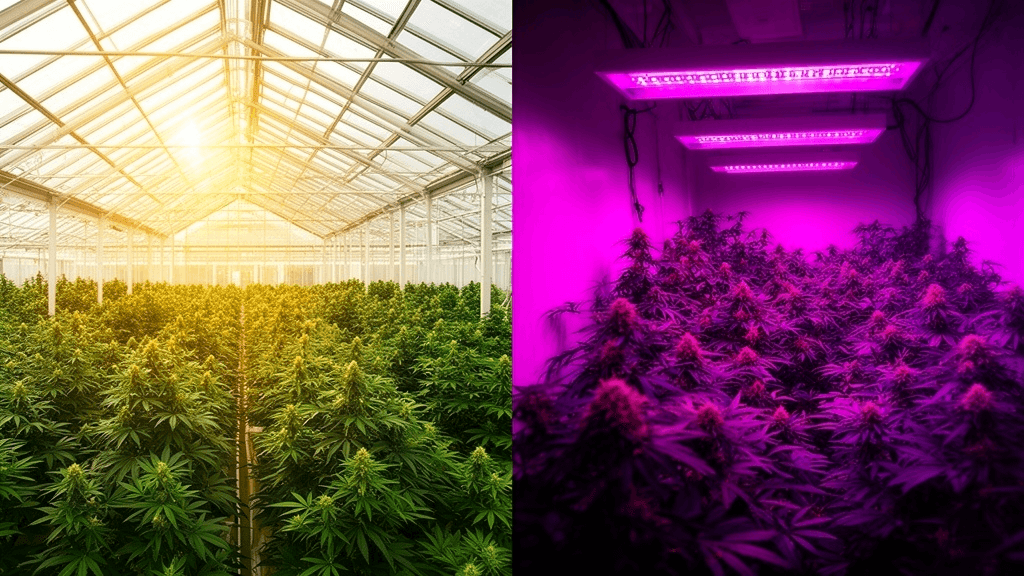
Cannabis photobiology research: what the science actually says
Dr. Bruce Bugbee, Distinguished Professor of Crop Physiology at Utah State University, leads one of the few university-licensed cannabis research programs in the United States. His laboratory has produced the most rigorous controlled-environment cannabis photobiology data available.
Key findings from peer-reviewed publications include a consistent 12% yield decrease as blue photon fraction increased from 4% to 20% at PPFD of 750–900 µmol/m²/s, demonstrating that fixture efficacy matters more than spectral composition. Research established that 25 mg/L phosphorus is adequate for cannabis in controlled environments with elevated CO₂, and demonstrated that UV supplementation does not increase cannabinoid concentration in high-CBD cultivars — contradicting industry assumptions.
The critical CO₂ optimization data shows that enrichment from ambient (~420 ppm) to 1,200 ppm increased yield by approximately 40%, with 95% of the yield increase occurring between ambient and 1,200 ppm. Further enrichment to 1,400 ppm produced minimal additional benefit. This response was consistent across multiple cultivars and daily light integrals.
Research from the University of Guelph found a linear yield increase up to 1,800 µmol/m²/s of photosynthetically active radiation, with single-leaf photosynthetic saturation at approximately 1,400 µmol/m²/s. However, photon conversion efficacy decreases at very high PPFD even as absolute yield continues to increase — defining the economic optimum that greenhouse operations can target using natural sunlight.
Regulatory acceptance: the EMA now explicitly endorses greenhouse cultivation
The revised EMA guideline on Good Agricultural and Collection Practice (EMEA/HMPC/246816/2005 Rev. 1), adopted in July 2025 and published in August 2025, represents the single most important regulatory development for greenhouse-based pharmaceutical cannabis in Europe.
The revision explicitly addresses "outdoor, greenhouse and indoor cultivation" — placing all three on equal regulatory footing for the first time. Section 5 specifies that indoor cultivation facilities should contain adequate systems for air, climate, humidity, light, ventilation, and air filtration. Section 7 requires that for indoor and greenhouse cultivation, all agronomic conditions and materials used must be fully documented.
The European Pharmacopoeia monograph 3028 (Cannabis Flower), effective 1 July 2024, sets quality specifications achievable in controlled-environment greenhouses. The monograph defines cannabinoid content requirements (±10% of label claim), heavy metal limits stricter than general herbal drug standards, microbial quality requirements, and pesticide residue limits. These specifications are facility-type agnostic — they define outcome standards, not process requirements.
The PIC/S GMP framework (PE 009-17) applies from post-harvest onward, with Annex 7 governing herbal medicinal products. The regulatory chain is clear: GACP governs cultivation, GMP Part II governs initial processing, and GMP Part I governs finished product manufacturing — regardless of whether cultivation occurs in a greenhouse or indoor facility.
The energy equation: a 10× difference
The most authoritative comparative energy data comes from the Northwest Power and Conservation Council, surveying 90 cannabis facilities in Oregon and Washington. Indoor facilities consumed 128 kWh per square foot of canopy annually versus just 12 kWh/sq ft for greenhouses — a 10.7× difference. Lighting accounted for 66% of indoor electricity.
Energy represents 20–40% of total indoor operating costs. Foundational research estimated indoor cannabis consumed approximately 1% of total US electricity, with updated estimates suggesting $11 billion annually by 2025. A lifecycle assessment across 1,011 US locations found greenhouse gas emissions of 2,283–5,184 kg CO₂-equivalent per kg of dried flower for indoor operations.
Production cost benchmarks by geography reveal the scale of the difference:
- US indoor median: ~$1.04/g direct production cost
- Canadian indoor: ~CAD $1.50–2.52/g all-in production cost
- US greenhouse median: ~$0.47–0.48/g, representing 35% savings versus indoor
- African greenhouse: $0.15–0.50/g cultivation cost
Well-designed greenhouses save 60–70% per gram versus standard indoor grows according to energy efficiency analyses.
Sealed Venlo technology: pharmaceutical-grade at greenhouse cost
The Venlo greenhouse design originated in the Netherlands, and approximately 90% of all glass greenhouses worldwide are of Dutch origin. The structure consists of an aluminium roofing system for maximum light transmission mounted on a hot-dip galvanized steel sub-frame.
What makes a "sealed" Venlo different from conventional greenhouses is the replacement of passive roof ventilation with active mechanical air handling units that create positive overpressure inside the greenhouse. This positive pressure keeps insects and pathogens out, enables precise CO₂ enrichment (retained rather than vented), and achieves energy savings of 15–50% over traditional greenhouses.
Construction cost comparison
Complete turnkey Venlo systems show strong economies of scale, with basic systems at approximately €247/m² and expert-class systems at approximately €281/m² for one-acre deployments. A pharmaceutical-grade sealed Venlo with full environmental controls likely costs €400–600+/m².
Indoor cannabis facility construction runs dramatically higher. Multiple industry sources converge on $250–650 per square foot total buildout ($2,700–7,000/m²). Even construction-only costs range from $1,075–3,230/m².The bottom line: a sealed pharmaceutical-grade Venlo greenhouse costs roughly $430–650/m² versus $2,700–7,000/m² for a purpose-built indoor facility — a 4–10× capital cost advantage.
Why pad-and-fan cooling disqualifies pharmaceutical production
Evaporative pad-and-fan cooling draws outside air through water-saturated cellulose pads using exhaust fans, creating negative pressure inside the greenhouse. This design has four fundamental incompatibilities with pharmaceutical cannabis production.
Microbial contamination is inherent: wet cellulose pads are ideal substrates for algae, biofilm, and pathogen growth. The system cannot maintain a sealed environment — it requires continuous outdoor air exchange, making HEPA filtration impossible. It operates on negative pressure (the opposite of GMP's positive pressure requirement). And it introduces uncontrolled humidity with temperature gradients of 7–10°F across the greenhouse length. Closed-loop glycol systems eliminate all four problems. A sealed, pressurized glycol circuit absorbs heat from indoor fan coil units and rejects it to the atmosphere through external closed-circuit coolers — the process fluid never contacts building air. The building remains fully sealed with positive pressure, HEPA-filtered make-up air, validated temperature/humidity uniformity, and full compatibility with GMP/GACP requirements.Filtration requirements for pharmaceutical cannabis
ASHRAE Standard 52.2 defines the MERV rating system. MERV-8 captures ≥70% of particles at 3.0–10.0 µm but has no tested efficiency below 1.0 µm. MERV-13 captures ≥50% at 0.3–1.0 µm. HEPA H13 captures ≥99.97% at 0.3 µm — the jump from MERV-16 to HEPA represents a 60× reduction in particle penetration.
EU GMP Annex 1 requires terminal HEPA filtration for all classified cleanroom grades. The standard pharmaceutical HVAC filtration cascade uses MERV-7/8 as a pre-filter, MERV-13–15 as secondary, and HEPA H13/H14 as terminal filtration.
For a sealed Venlo greenhouse targeting pharmaceutical cannabis, the practical approach is MERV-13/14 secondary filtration with HEPA terminal filtration on make-up air, maintaining positive pressure to prevent unfiltered infiltration.
South Africa's solar advantage
Multiple independent sources confirm the South African Highveld receives 5.5–6.5 kWh/m²/day of global horizontal irradiance, with seasonal variation from approximately 4.8 kWh/m²/day in winter to 7.2 kWh/m²/day in spring.
At approximately 1,350m altitude, the Highveld benefits from 10–15% higher direct normal irradiance compared to equivalent sea-level latitude. Through greenhouse glass at 85–90% peak transmission, this delivers approximately 1,800–1,900 µmol/m²/s — well above the optimal 1,200 µmol/m²/s target for several hours daily in summer.
The comparative advantage is significant: 2.0–2.3× more annual solar radiation than the Netherlands, 2.1–2.4× more than Denmark, and 1.8–2.1× more than Ontario, Canada. The winter advantage is most pronounced: approximately 25 mol/m²/d inside a greenhouse versus just 3–5 mol/m²/d for Northern Europe, requiring roughly half the supplemental lighting intensity year-round and translating to estimated 50–70% savings on supplemental lighting energy.
The Dutch and Danish precedent: 170 years of greenhouse innovation
Dutch greenhouse horticulture evolved through five distinct phases that cannabis is now replicating. From basic glass structures in the mid-1850s through post-war expansion, the climate computer revolution, and the current sealed/semi-closed frontier, the Netherlands has systematically pushed greenhouse technology toward pharmaceutical-grade capability.
Wageningen University's "Kas als Apotheek" (Greenhouse as Pharmacy) program explicitly researches greenhouse production of pharmaceutical-grade botanicals including cannabis, investigating whether cannabinoid and terpene content can be controlled through specific cultivation strategies.
The most compelling conversion case is Village Farms International, which converted its 1.1 million square foot Delta 3 greenhouse from tomatoes to cannabis in just 7 months. Its cannabis subsidiary now produces the top-selling dried flower in Canada, is EU-GMP certified, and exports to Germany, Australia, and the UK.
Denmark's convergence of greenhouse expertise and pharmaceutical industry created a European cannabis production hub. Schroll Medical transitioned from hydrangea greenhouses to achieve EU-GMP certification from the Danish Medicines Agency in November 2019, demonstrating that greenhouse infrastructure can meet the highest pharmaceutical standards.
Conclusion
The evidence converges on several conclusions with high confidence. The photobiology is settled: optimal CO₂ and light levels are readily achieved in sealed greenhouses. The regulatory pathway is now unambiguous: the revised EMA GACP guideline explicitly accepts greenhouse cultivation, and quality standards are facility-type agnostic. The economics strongly favour greenhouses: 4–10× lower capital costs, 10.7× lower energy consumption per square foot, and 35–54% lower production costs per gram. The engineering solutions exist: sealed Venlo greenhouses with closed-loop cooling and cascaded MERV/HEPA filtration achieve pharmaceutical-grade environmental control. And the precedent is compelling: 170 years of Dutch greenhouse innovation and real-world EU-GMP certifications demonstrate that pharmaceutical consistency does not require an indoor warehouse — it requires environmental control, which modern sealed Venlo technology delivers at dramatically lower cost.
Stay informed
European Cannabis Market Intelligence — Monthly
Regulatory updates, market analysis, and cultivation insights for pharmaceutical cannabis professionals.
Related Articles
From Seed to Shipment: A Practical Guide to Exporting Medical Cannabis to Europe
14 February 2026 · 12 min read
Read Article →Germany's Medical Cannabis Market: Explosive Growth Reshapes Europe's Largest Opportunity
12 February 2026 · 10 min read
Read Article →Africa's Bid to Become Europe's Cannabis Breadbasket
10 February 2026 · 10 min read
Read Article →